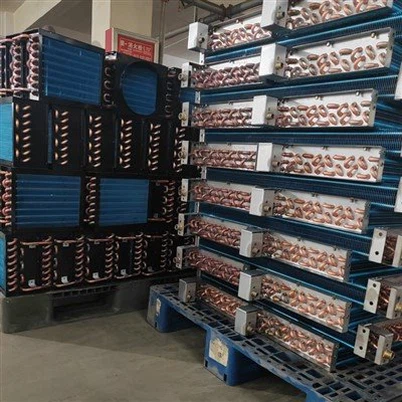


Microchannel Heat Exchanger
Leave a message
Microchannel, also known as microchannel heat exchanger, is a heat exchanger with an equivalent diameter of 10-1000μm. The flat tube of the heat exchanger has tens of small flow channels, and the two ends of the flat tube are connected with the circular collector. A separator is arranged in the collector tube to separate the flow path of the heat exchanger into several flows.
Type Material processing mode Type
Micro-channel heat exchangers can be divided into micro-channel heat exchangers and large-scale micro-channel heat exchangers according to their dimensions.
Micro-micro-channel heat exchanger is a kind of compact, lightweight and efficient heat exchanger designed to meet the needs of the development of electronic industry. Its structure forms include plate cross-flow micro-heat exchanger and sintered mesh porous micro-heat exchanger.
The large-scale micro-channel heat exchanger is mainly used in traditional industrial refrigeration, waste heat utilization, automobile air conditioning, household air conditioning, heat pump water heater and so on. The structure forms are parallel flow tube radiator and three-dimensional cross-flow radiator. Due to the large size of the exterior (up to 1.2mx4mx25.4mm), the hydraulic diameter of the micro-channel is below 0.6~1mm, so it is called a large-scale micro-channel heat exchanger.
Materials
The materials available for micro micro channel heat exchangers are: polymethyl methacrylate, nickel, copper, stainless steel, ceramics, silicon, Si3N4 and aluminum. The heat transfer performance per unit volume of the micro-channel heat exchanger using nickel material is more than 5 times higher than that of the corresponding polymer material, and the heat transfer performance per unit mass is also increased by 50%.
Using copper material, the metal plate can be processed into a small and smooth fluid channel, the fin size and plate thickness can be accurately controlled, reaching tens of microns, and the plate cross-flow structure can be formed by brazing, and the heat transfer coefficient can reach 45MW/(m3·K), which is 20 times that of traditional compact heat exchangers.
The use of silicon, Si3N4 and other materials can be manufactured structure more complex multi-layer structure, through the anisotropic etching process can complete the processing of new heat exchangers, the use of sandwich and stacking technology can be manufactured a variety of structures and sizes, such as the channel for the pyramid structure of the heat exchanger.
Processing mode
With the improvement of micro-machining technology, efficient micro-heat exchangers with flow channel depths ranging from a few microns to several hundred microns can be processed. Such micromachining technologies include: lithography, chemical etching technology, lithography electrocasting injection molding technology (LIGA), diamond cutting technology, wire cutting and ion beam processing technology. Sintered mesh porous micro heat exchanger is made by powder metallurgy. Microchannel processing at large scale is significantly different from microchannel processing at micro scale, and the former requires more efficient processing and manufacturing technology.
Application prospect and advantage
Microelectronics and other fields of application
The field of microelectronics follows the rapid development of Moore's law, with the continuous improvement of transistor integration, the heat density of high-speed electronic devices has reached 5~10MW/m2, heat dissipation has become the main "bottleneck" of its development, and the replacement of traditional heat exchange devices by micro-channel heat exchangers has become an inevitable trend. Therefore, microchannel heat exchangers will have broad application prospects in many fields such as aerospace, modern medical treatment, chemical and biological engineering, which are highly dependent on embedded technology and high-performance computing.
Air conditioning and water heater applications
With the gradual maturity of micro-channel heat transfer technology, the automotive air conditioning industry and home air conditioning industry (such as Midea) have begun to produce related products. Fortunately, the current hot air energy water heater industry has also begun to enter the field of microchannels. In 2012, Guangdong Tongyi Electric Appliance Co., LTD., known as the "air energy creator", developed a microcycle heat pump unit. Announced the successful application of "micro-channel" technology to the air energy industry, marking the air energy water heater industry into the "micro-channel" era.
Application advantage
① Energy saving. Energy saving is an important index of today's air conditioner. Conventional heat exchangers are difficult to produce high-grade products such as Class I energy efficiency standards, and micro-channel heat exchangers will be the best choice to solve the problem.
② Excellent heat transfer performance. In household air conditioning, when the flow channel size is less than 3mm, the gas-liquid two-phase flow and phase change heat transfer law will be different from the conventional larger size, the smaller the channel, the more obvious this size effect. When the inner diameter of the tube is as small as 0.5~1mm, the convective heat transfer coefficient can be increased by 50%~100%. Applying this enhanced heat transfer technology to air conditioning heat exchanger, it is expected that the heat transfer of air conditioning heat exchanger can be effectively enhanced and its energy saving water can be improved by appropriately changing the structure, process and enhanced heat transfer measures on the air side
Yes.
③ Promotion potential. Micro-channel heat exchanger technology also has the potential to promote air energy water heaters in the field of air conditioning manufacturing, which can greatly improve the competitiveness of products and the sustainable development of enterprises.
Compared with conventional heat exchangers, micro-channel heat exchangers are not only small in size, large in heat transfer coefficient, high in heat transfer efficiency, and can meet higher energy efficiency standards, but also have excellent pressure performance, can be CO2 as the working medium refrigeration, in line with environmental protection requirements, has attracted extensive attention from academia and industry at home and abroad. The key technology of micro-channel heat exchangers - the production method of micro-channel parallel flow tube has gradually matured in China, which makes the large-scale use of micro-channel heat exchangers possible.