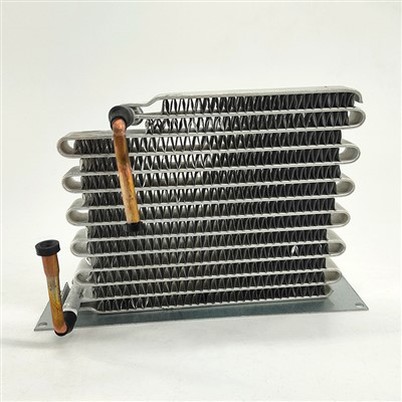


What medium is easily damaged by condenser evaporator in production?
Leave a message
In the industrial production process, the condenser as a long-term uninterrupted refrigeration heat exchange auxiliary equipment, because of the different production needs, the cooling heat exchange medium used is also different, often the heat exchanger (cold zone device, condenser, evaporator) the most likely problem is the internal dirt blockage and shell corrosion, then, Which specific production media are likely to lead to similar problems?
1. Impurities dissolved in water in ionic or molecular states are harmful
A. The main components of calcium salts in water are Ca (HCO3) 2, CaCl2, CaSO4, CaSiO3, etc. Calcium salt is the main component of heat exchanger fouling. Among them, CaSO4 is a kind of hard, crystalline scale, loose structure, small adhesion, is a relatively soft mud, separated from the water has fluidity, even if attached to the heating surface is easy to remove.
b, the main composition of magnesium salts in water are Mg(HCO3), MgCl2, MgSO4 and so on. After magnesium is dissolved in water, it is decomposed by heat to form Mg(OH)2 precipitate, and Mg(OH)2 is also a sludge scale. MgCl2 and MgSO4 dissolved in water will cause acid corrosion of metal walls due to hydrolysis when the pH of water is <7.
c, sodium salts are mainly composed of NaCl, Na2SO4, NaHCO3 and so on. NaCl does not generate scale, but there is free oxygen in the water, which will accelerate the corrosion of the metal wall. The content of Na2SO4 is too high, which will salt on the accessories after the evaporator, affecting the safe operation; NaHCO3 in water will decompose NaCO3, NaOH and CO2 under the action of temperature and pressure, which will damage the metal grains.
2, the harm of dissolved oxygen gas
There are many reasons for corrosion of heat exchangers, but the most serious corrosion and the fastest is oxygen. On the atomic order table, the potential of iron is above hydrogen, and in neutral water without oxygen, the iron atom on the metal surface of the system loses electrons to form a divalent ion (FE-2E →Fe2+), and the Fe2+ ion and the OH- ion in water are combined under electrostatic attraction [Fe2++2OH-→Fe(OH)2], and the following equilibrium is established in the water:
Fe2++2OH-=Fe(OH)2
When oxygen is present in the water, Fe(OH)2 is further oxidized into insoluble iron hydroxide precipitation:
4Fe(OH)2+O2+2H2O→4Fe(OH)3↓
Due to the precipitation of Fe(OH)3, the iron ions around the anode are transferred to the aqueous solution, which accelerates the corrosion.
It can be seen from the above reaction that water and oxygen are the necessary conditions for corrosion, the anode part is the part of corrosion, and the cathode part is the part of corrosion product accumulation. When the corrosion is basically uniform on the entire metal surface, the speed of corrosion will not be very fast, so it is not harmful, and this corrosion is called comprehensive corrosion. When the corrosion is concentrated on certain parts of the metal surface, it is called local corrosion. The speed of local corrosion is very fast, easy to rust through, pit corrosion is a common local corrosion in the heat exchanger, so it is very harmful.
3, the harm of impurities in the colloidal state to the heat exchanger
a, the main component of iron compounds is Fe2O3, which will produce iron scale. When the water contains a lot of iron compounds, the water is often yellow.
b, microorganisms due to the air conditioning cooling of the circulating water temperature, dissolved oxygen, nutrients, etc., provide conditions conducive to the reproduction of microorganisms, microorganisms will breed in large numbers. Microorganisms come from the soil and air, cooling the temperature of the circulating water is higher, after the cooling tower aeration, oxygen content increases, often add phosphate and other agents in the water, just the microorganism's nutrients, the cooling tower is mostly located in the open air, sunlight is conducive to the growth of algae, the propagation of microorganisms not only blocks the plate channel, sometimes will block the pipeline, but also make metal corrosion.
c, the sludge in the circulating water of sludge cooling comes from the dust in the air and the suspended matter in the supplementary water. During the convective exchange of air and water, a large amount of air is sprayed with circulating water in the tower, so that dust enters the water and is gradually deposited in the heat exchanger with a lower flow rate.
d, sticky scale is mainly the secretion of microorganisms and water sediment, corrosion products, bacteria and algae remains bonded to form, they are often attached to the wall of the heat exchanger, produce a variety of organic acids, this acid can also cause corrosion.
Therefore, the heat exchanger fluid water quality requirements are very important, in the operation management, should pay more attention to be equipped with some necessary anti-scale, anti-corrosion equipment, extend the service life of the equipment.
Based on the above points, we can judge the reasons for similar situations in the heat exchanger in the production process.