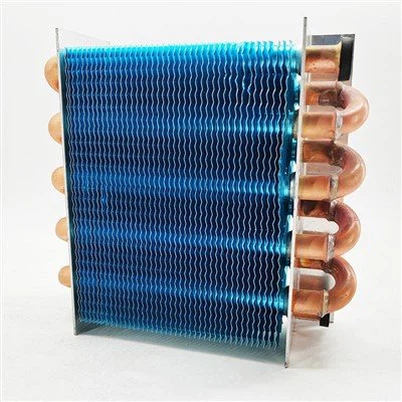


Refrigeration principle of finned evaporator
Leave a message
The refrigeration compressor of the general refrigerator is mainly used to press the low pressure steam into the high pressure steam, thereby reducing the volume of the steam and increasing the pressure.
The compressor inhales the low-pressure steam of the working medium of the evaporator, enters the condenser after the pressure, condenses the condenser of the cold high-pressure liquid, the throttle valve throttles, becomes the low-pressure liquid, enters the evaporator, the heat of the evaporator evaporates and becomes a low-pressure steam, and then enters the inlet of the evaporator, thus completing the refrigeration cycle.
1. Principle of steam compression refrigeration.
The single stage steam compression refrigeration system is composed of four basic parts: refrigeration compressor, condenser, evaporator and throttle valve. They are connected by pipes, forming a closed system in which the refrigerant constantly circulates, changing states and exchanging heat with the outside world.
The liquid refrigerant in the evaporator is cooled by the object to absorb heat, evaporates into low temperature and low pressure steam, compressor, compressed into high temperature and high pressure steam into the condenser, the cooling medium of the condenser (water or air), heat release, condensation of high pressure liquid, low temperature and low pressure refrigerant throttle, and again into the evaporator to evaporate heat, to achieve the purpose of circulation refrigeration. In this way, the refrigerant can complete the refrigeration cycle through four basic processes: evaporation, compression, condensation, and throttling.
In the refrigeration system, evaporator, condenser, compressor and throttle valve are the four basic components of the refrigeration system. The refrigerant absorbs heat from the cooled body to achieve refrigeration. The compressor is the heart, which acts to inhale, compress and transport refrigerant vapors. The condenser is a device that releases heat through the heat of the evaporator and the heat of the compressor to the cooling medium. The throttle valve is used to control and regulate the amount of refrigerant liquid entering the evaporator. The system is divided into two parts: high pressure side and low pressure side. The actual refrigeration system, in addition to the above four items, often has some auxiliary equipment, such as solenoid valves, dispensers, dryers, collectors, fusible plugs, pressure controllers and other components to improve economic operation, reliability and safety.
2. Main components of refrigeration system.
According to the condensing form, the condenser can be divided into two types: water-cooled and air-cooled, and according to the use, it can be divided into two types of single-cooled warming and cooling systems, and a combination is composed of the following main components.
The main components of refrigeration system are compressor, condenser, evaporator, expansion valve (or capillary, cooling control valve), four-way valve, double valve, check valve, solenoid valve, pressure switch, plug, output pressure regulator, pressure controller, storage tank, heat exchanger, collector, filter, dryer, automatic shutter, stop valve, liquid slug injection, etc.
The main components of the refrigeration system are compressor, condenser, evaporator, expansion valve (or capillary, supercooling control valve), four-way valve, multiple valve, check valve, solenoid valve, pressure switch, fuse, output pressure regulating valve, pressure controller, liquid storage tank, heat exchanger, collector, filter, dryer, automatic opening and closing device, stop valve, liquid injection plug and other components.
The control system consists of several control devices. They are:
Refrigerant controller: expansion valve, capillary, etc.
Refrigerant loop controller: four-way valve, check valve, double valve, solenoid valve.
Refrigerant pressure controller: pressure switch, output pressure regulator, pressure controller.
Motor protector: overcurrent relay, thermal overcurrent relay, temperature relay. Temperature regulator:
Temperature position regulator, temperature proportional regulator. Humidity regulator: Humidity regulator.
Defrosting controller: defrosting temperature switch, defrosting time relay, various temperature switches.
Cooling water control: water break relay, water flow control valve, water pump, etc.
Alarm control: over-temperature alarm, ultra-wet alarm, low-pressure alarm, fire alarm, smoke alarm, etc.
Other controls: indoor fan speed controller, outdoor fan speed controller, etc.
As shown in 3. Common refrigerants and their properties.
There are many refrigerants, which are briefly described in Freon 12 and 22.
A. Freon 12(CF2Cl2) is a colorless, odorless, transparent, almost non-toxic refrigerant, but more than 80% of the air content can cause suffocation. Freon 12 does not burn, does not explode, and can break down harmful hydrogen fluoride, hydrogen chloride, and light gases (CoCl2) when exposed to open flames or temperatures above 400 degrees. Refrigerant R12 is a widely used medium temperature, suitable for small and medium-sized refrigeration systems, such as refrigerators, freezers, etc. R12 can dissolve a variety of organic compounds, so it is not possible to use a universal rubber gasket (ring), usually with chloroprene rubber or butadiene rubber sheet or seal.
freon 22(CHF2Cl) R22 R22 does not burn or explode. Its toxicity is slightly greater than R12, and the solubility of water is greater than R12, but it can still cause "ice jams" in refrigeration systems. R22 can be partially dissolved in lubricating oil, and its solubility varies with the type and temperature of lubricating oil. Therefore, the refrigeration system of R22 must have oil recovery measures.
The evaporation temperature of R22 under the standard atmospheric pressure is 40.8℃, the temperature condensation pressure is not more than 15.68 x 10⁵ Pa, and the cooling capacity and unit volume are more than 60% greater than R12. R22 refrigerant is used in air conditioning equipment.