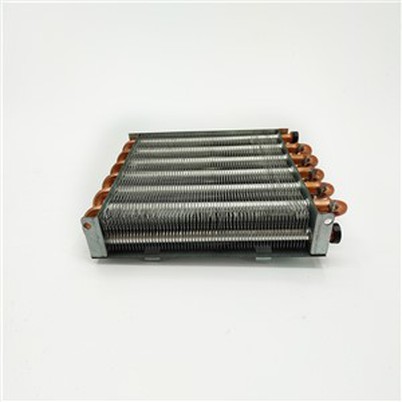


What Is Inner Grooved Copper Tube? Key Benefits in HVAC Heat Exchangers
Leave a message

Advantages and Characteristics of Internally Threaded Copper Tubes
Compared with smooth copper tubes, internally threaded copper tubes adopt enhanced heat transfer mechanism. Under the same flow rate, their heat transfer coefficient can be increased by 1.5 to 3 times, which greatly reduces the overall size and investment cost of heat exchangers.
Turbulence Enhancement
Swirl Effect
Vortex Generation
II. Application Advantages of Internally Threaded Copper Tubes
Internally threaded copper tubes are mainly applied to heat exchangers in refrigeration and air conditioning systems, such as condensers and evaporators.
Compared with traditional smooth copper tubes, their application advantages are reflected in the following aspects:
1.High heat transfer coefficient Internally threaded copper tubes deliver remarkable heat transfer enhancement. Under the same working conditions, the heat transfer coefficient of the heat exchanger can be increased by more than 50%, which greatly reduces the heat exchanger size and saves materials and installation space.
2. Uniform refrigerant distribution The internal thread structure facilitates the distribution and turbulence of gas-liquid two-phase refrigerant, suppresses unfavorable phenomena such as dry patches and flow slippage, and improves the effective utilization rate of heat exchangers.
3. High system efficiency The use of internally threaded copper tubes effectively reduces the temperature difference between the inlet and outlet of the heat exchanger, lowers compressor power consumption, and increases the system Energy Efficiency Ratio (EER) by 5%~10%.
4. Wide adaptability Internally threaded copper tubes feature good compatibility with various refrigerants. They exhibit excellent heat transfer performance with new environmentally friendly refrigerants replacing R22, supporting the popularization and application of eco-friendly refrigerants.
5. Easy maintenance and cleaning The spiral flow inside the tube reduces adhesion of scale, oil dirt and other sediments, extends the cleaning cycle, and cuts down long-term maintenance costs.

Welding Process Requirements for Internally Threaded Copper Tubes
Selection of Welding Methods
Internally threaded copper tubes are mainly connected to pipe joints and fittings by brazing or fusion welding.
Brazing features a relatively low welding temperature, causing slight changes to the microstructure and performance of joints with low residual stress. It is mostly applied to occasions requiring high joint strength.
Fusion welding comes with a higher temperature and a wider heat-affected zone, leading to obvious changes in the structure and performance of welded joints. It is generally used for scenarios with ordinary requirements on joint strength.
Welding Quality Requirements
Internally threaded copper tubes impose strict standards on welded joint quality. Qualified welds require full and smooth filler transition with base materials without welding defects such as weld beads and undercuts, featuring smooth surfaces free of cracks, burn-through and slag inclusions, while the weld reinforcement shall be controlled within 1mm. Meanwhile, welded joints must attain over 90% of the base material's tensile strength with comparable hardness. In terms of tightness and durability, joints need excellent sealing performance to withstand 24-hour pressure holding tests at 1.25 times the working pressure without leakage, and deliver corrosion resistance equivalent to the base material with no obvious corrosion marks after simulated working condition tests.
Welding Process Control
To guarantee the qualified quality of welded joints for internally threaded copper tubes, standardized process control measures must be implemented throughout the welding procedure. Before welding, copper tube ends shall be polished to remove oxide layers and degreased with acetone and other solvents. Professional tooling such as pipe clamps and positioning brackets is adopted during assembly to ensure assembly accuracy and prevent misalignment and deformation, with the clamping gap controlled at 0.05mm and the clamping depth set to twice the tube wall thickness. Welding parameters including current and voltage shall be optimized according to tube specifications and welding types to maintain the joint linear energy within 10~20J/mm for stable heat input. Intermittent and symmetrical welding methods are applied for root welding, where the weld bead width is kept 2 to 3 times the copper tube wall thickness. For multi-layer and multi-pass welding, the inter-pass temperature is strictly controlled below 150℃ to reduce residual stress and structural deformation. Annealing or normalizing heat treatment can be performed on welded joints when necessary to eliminate residual stress and restore the structural and mechanical properties of welded components.