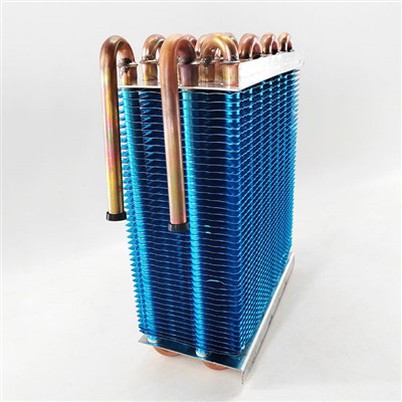


Miniaturization Design of Finned Tube Heat Exchanger
Leave a message
I. Challenges of Miniaturization for Finned Tube Heat Exchangers
With the increasing requirements for integration and energy saving of HVAC systems, the miniaturization and lightweight design of equipment have become an inevitable trend. As one of the core components, finned tube heat exchangers are confronted with the following challenges brought by miniaturization:
(1) It is difficult to improve heat transfer efficiency simultaneously.
(2) The difficulty of structural design is increased.
(3) The control of manufacturing processes becomes more challenging.
(4) The structural strength of fins is relatively low.
(5) The manufacturing cost remains relatively high.
In summary, to realize the miniaturization development of finned tube heat exchangers, technological innovations are required in many aspects so as to achieve high efficiency and energy saving.
Technical Innovation Points of Finned Tube Heat Exchangers
(1) Small-diameter Tube
The direct motivation for adopting small-diameter tubes is to reduce the consumption of copper materials and cut down production costs.
Advantages of Small-Diameter Tubes
1.Reduce production cost: Smaller tube diameter allows thinner tube wall thickness.
2.Improve heat transfer efficiency: Refrigerant can achieve better heat exchange with the tube.
3.Minimize the overall size of air conditioning units.
4.Reduce refrigerant charging amount.
(2) Advanced Corrosion Protection Coating
Coating technology improves the corrosion resistance and antifouling performance of heat exchangers, and extends their service life.
(3) Precision CNC Machining
High-precision CNC machine tools guarantee the manufacturing accuracy of miniaturized finned tubes.
(4) Deep Learning Optimized Design
Deep learning algorithms are adopted to optimize the finned tube structure and maximize heat transfer performance.
(5) New Filling Technology
The new filling process improves the filling quality of finned tubes and reduces thermal resistance.
Structural Design of Small-Diameter Tube Heat Exchangers
(1) Fine and Dense Fins
The overall size of fins is reduced and fin density is greatly increased, which enlarges the heat transfer area per unit volume.
Adopting lower fin height shortens the air flow path and reduces flow resistance.
Reduced fin spacing facilitates turbulence and secondary flow, thereby enhancing heat transfer.
The high-density fin structure improves the structural strength of the heat exchanger.
Precision CNC machining technology is required to manufacture high-density fine fins.
(2) Advanced Corrosion Protection Coating
Small-diameter tube heat exchangers have a higher demand for corrosion protective coatings to ensure long-term and efficient operation.
Industrial-grade anti-rust coatings are applied to enhance corrosion resistance.
Special antibacterial and antifouling coatings can also be considered.
Optimizing the coating process reduces coating thermal resistance and improves heat exchange performance.
Different coatings can be adopted for different parts to realize functional design.
(3) High-Strength Fin Materials
High-strength aluminum alloy, stainless steel and other materials are used to guarantee the mechanical strength of fins.
Careful material selection achieves a balance between structural strength and thermal conductivity.
Special composite materials with high thermal conductivity can be developed.
Material strengthening methods such as surface treatment can be adopted for performance improvement.
Fins in different positions can adopt different materials to realize lightweight design.
(4) High-Precision Sharp Fins
Fin edges are designed into a sharp shape to effectively reduce resistance loss during air flow.
Precision CNC machining is required to fabricate high-precision sharp fins.
Fins at different positions can be designed with different sharpness to optimize flow characteristics.
Sharp fins also strengthen turbulence effect and increase the local heat transfer coefficient.
Attention shall be paid to the safety of sharp fins to avoid scratch damage.