

Why Copper Tube Aluminum Fin Condensers Dominate Industrial Refrigeration & HVAC Systems
Leave a message
Industrial Copper Tube Aluminum Fin Condensers: High Efficiency & Durability for HVAC & Refrigeration Systems
In the competitive HVAC and industrial refrigeration industry, selecting the right heat exchanger directly impacts system efficiency, operational costs, and long-term reliability. Among all condenser types, copper tube aluminum fin condensers stand out as the most trusted choice for wholesalers, engineering procurement teams, and industrial cooling contractors worldwide. This blog explores their core advantages, working principles, key applications, and why they deliver unmatched value for your industrial and commercial projects.


What Is an Industrial Copper Tube Aluminum Fin Condenser?
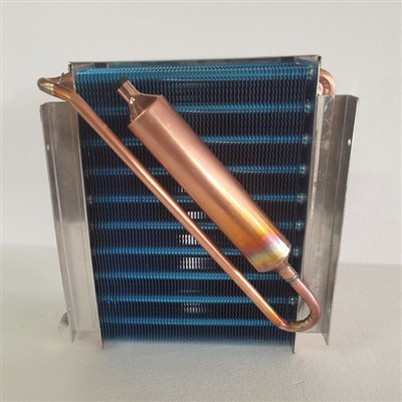
An industrial copper tube aluminum fin condenser is a high-performance air-cooled heat exchanger designed to remove heat from refrigerant vapor and convert it into liquid in refrigeration, air conditioning, and heat pump systems. Its hybrid construction combines two premium materials:
Copper Tubes: High-purity TP2 copper tubes (typically Φ7–15.88 mm) with excellent thermal conductivity (≈400 W/m·K) and high-pressure resistance, ensuring fast heat transfer and structural durability.
Aluminum Fins: Lightweight aluminum fins (0.12–0.2 mm thick) with louvered, corrugated, or flat designs, expanded to tightly bond with copper tubes. Aluminum's low density (3x lighter than copper) maximizes heat dissipation area while keeping the unit lightweight.
This "copper-aluminum" hybrid design balances superior heat transfer efficiency, corrosion resistance, and cost-effectiveness-a critical advantage over all-aluminum microchannel or steel tube alternatives.
Core Advantages for HVAC & Refrigeration Wholesalers
1. Unmatched Thermal Efficiency & Energy Savings
Copper's thermal conductivity is 68% higher than aluminum (400 vs. 237 W/m·K), enabling copper tubes to absorb and release heat far faster. Aluminum fins, responsible for 65–70% of total heat transfer, maximize airflow contact area. Together, they deliver 20–30% higher heat transfer efficiency than all-aluminum condensers, reducing energy consumption for industrial cooling systems by up to 25%-a key selling point for cost-focused industrial buyers.
2. Exceptional Durability & Long Service Life
Copper Tubes: Resist corrosion, oxidation, and high refrigerant pressures (up to 3.0 MPa), withstanding harsh industrial environments (humidity, dust, chemical exposure) without leaks or deformation.
Protected Aluminum Fins: Optional hydrophilic or epoxy coating prevents galvanic corrosion and fouling, extending service life to 15–20 years-far longer than microchannel condensers (5–8 years).
Robust Construction: Precision tube expansion and brazing ensure leak-proof joints, reducing maintenance costs and downtime for end-users.
3. Cost-Effective & Easy to Maintain
While copper-aluminum condensers have a slightly higher upfront cost than all-aluminum options, their long-term savings are substantial:
Lower energy bills for industrial facilities.
Minimal maintenance (easy cleaning of aluminum fins, no frequent replacements).
Higher resale value for HVAC systems.
For wholesalers, this means strong customer retention and fewer after-sales complaints-critical for building long-term partnerships with engineering contractors.
4. Full Customization for Diverse Industrial Applications
We offer OEM/ODM customization to meet unique project requirements:
Tube Specifications: Smooth or inner-grooved copper tubes (Φ7, Φ7.94, Φ9.52, Φ12.7 mm).
Fin Designs: Louver, corrugated, flat, or hydrophilic-coated fins (fin spacing: 1.8–5.8 mm).
Dimensions & Configurations: Custom coil sizes, V-type, flat-type, or vertical arrangements for cold rooms, chillers, and industrial air conditioners.
Certifications: CE, RoHS, and ISO certifications to comply with global industrial standards.