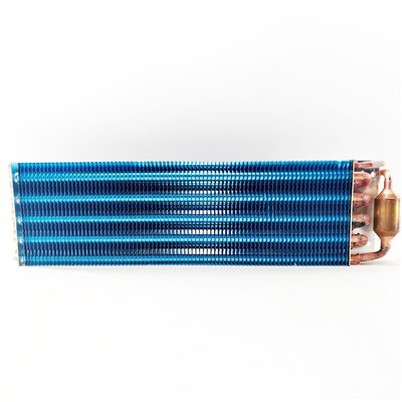


Principle of condenser
Leave a message
The gas passes through a long tube (usually coiled into a solenoid), allowing heat to be lost to the surrounding air. Metals such as copper, which conduct heat, are often used to transport steam. In order to improve the efficiency of the condenser, heat sinks with excellent heat conduction performance are often attached to the pipes to increase the heat dissipation area to accelerate heat dissipation, and the air convection is accelerated through the fan to take away the heat.
In the circulating system of the refrigerator, the compressor inhales low-temperature and low-pressure refrigerant steam from the evaporator, which is adiabatic compressed into high-temperature and high-pressure superheated steam by the compressor, and then pressed into the condenser for constant pressure cooling, and releases heat to the cooling medium, and then cooled into the supercooled liquid refrigerant. The liquid refrigerant becomes a low-pressure liquid refrigerant through the expansion valve adiabatic throttling, evaporates and absorbs the heat in the air conditioning circulating water (air) in the evaporator, thus cooling the air conditioning circulating water to achieve the purpose of refrigeration, and the refrigerant flowing out of the low pressure is sucked into the compressor, so the cycle works.
Single-stage steam compression refrigeration system is composed of four basic components of refrigeration compressor, condenser, throttle valve and evaporator, which are successively connected by pipes to form a closed system, and the refrigerant constantly circulates in the system, changes state, and exchanges heat with the outside world.