

Composition of condenser
Leave a message
In the refrigeration system, the evaporator, the condenser, the compressor and the throttle valve are the four essential parts of the refrigeration system, in which the evaporator is the equipment that transmits the cold amount. The refrigerant absorbs the heat of the object being cooled to achieve cooling. The compressor is the heart, which plays the role of inhaling, compressing and transporting refrigerant steam. The condenser is a device that releases heat, transferring the heat absorbed in the evaporator along with the heat converted by the compressor work to the cooling medium. The throttle valve plays the role of throttling and reducing the pressure of the refrigerant, while controlling and regulating the amount of refrigerant liquid flowing into the evaporator, and the system is divided into two parts: the high pressure side and the low pressure side. In the actual refrigeration system, in addition to the above four large parts, there are often some auxiliary equipment, such as solenoid valves, dispensers, dryers, collectors, fusible plugs, pressure controllers and other components, which are set to improve the economy, reliability and safety of operation.
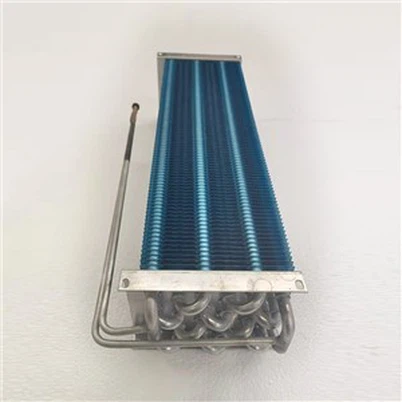
According to the condensing form, the air conditioner can be divided into water-cooled and air-cooled, and according to the purpose of use, it can be divided into single-cooled and refrigerated and warmed, no matter which type of composition, it is composed of the following main components.
The necessity of condenser is based on the second law of thermodynamics - according to the second law of thermodynamics, the spontaneous flow direction of heat energy inside a closed system is one-way, that is, it can only flow from high heat to low heat, and the microscopic particles that carry heat energy in the microscopic world can only change from order to disorder. Therefore, when a heat engine has energy input to do work, the downstream must also have energy release, so that there will be a thermal energy gap between the upstream and downstream, the flow of thermal energy will become possible, and the cycle will continue.
Therefore, if you want the carrier to do work again, you must first release the heat energy that is not completely released, and you need to use the condenser at this time. If the surrounding heat energy is higher than the temperature in the condenser, in order to cool the condenser, work must be done (generally using a compressor). The condensed fluid returns to a state of high order and low thermal energy, and work can be done again.
The selection of the condenser includes the choice of form and model, and determines the flow and resistance of the cooling water or air flowing through the condenser. The choice of condenser type should consider the local water source, water temperature, climate conditions, as well as the size of the total cooling capacity of the refrigeration system and the layout requirements of the refrigeration room. Under the premise of determining the condenser type, the heat transfer area of the condenser is calculated according to the condensing load and the heat load per unit area of the condenser, so as to select the specific condenser model.