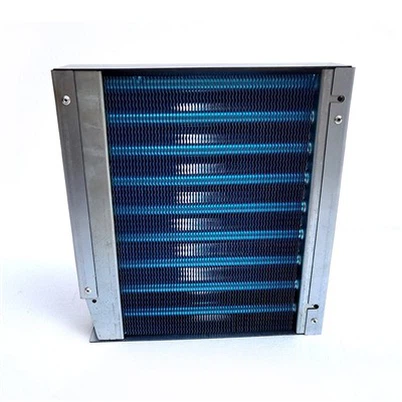


Working principle of air-cooled single-door condenser
Leave a message
Air-cooled single-door condenser is a common refrigeration equipment, mainly used for refrigeration, freezing and other occasions. It works as follows:
Condenser location: The air-cooled single-door condenser is generally located on the back or side of the refrigeration equipment, near the compressor.
Refrigerant flow: Refrigerant enters the condenser from the high temperature and high pressure state in the compressor and flows through the copper pipe inside the condenser.
Heat dissipation process: When the refrigerant flows in the copper tube inside the condenser, it exchanges heat with the air of the external environment. The outside of the condenser is covered with a layer of aluminum heat fin, which can expand the heat dissipation area and improve the heat transfer efficiency.
Fan assisted heat dissipation: The condenser is usually installed with one or more fans. Through the rotation of the fan, the air is blown through the heat dissipation fins of the condenser, speeding up the heat dissipation process and rapidly reducing the temperature of the refrigerant.
Condensate formation: With the flow and heat dissipation process of the refrigerant in the condenser, the temperature of the refrigerant gradually decreases, from the high temperature and high pressure state to the high pressure liquid state. At this time, the copper tube inside the condenser will absorb heat, making the temperature of the refrigerant lower.
Condensate discharge: There is usually a drain hole at the bottom of the condenser to discharge the refrigerant that has been condensed into a liquid state. The condensate flows out of the condenser through the drain hole and returns to the evaporator of the refrigeration system, completing one stage of the refrigeration cycle.
The air-cooled single-door condenser is assisted by the fan to dissipate heat, and the air is used to heat the refrigerant, and the heat is extracted from the refrigerant, so that it is quickly cooled and transformed into a liquid state. This can maintain the normal operation of the refrigeration system and provide the effect of refrigeration or freezing.