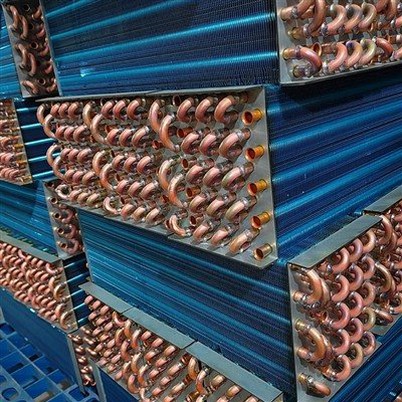


The difference between water-cooled condenser and air-cooled condenser
Jul 18, 2024
Leave a message
distinction
| Water-cooled condenser | Air-cooled condenser | |
| Cooling medium | Use water as a cooling medium. Water has high specific heat capacity, thermal conductivity and convection coefficient, so its heat transfer ability is strong. | use air as the cooling medium. These thermophysical properties of air are relatively low, resulting in a weak ability to transfer heat. |
| Cooling mode | circulates water through the surface of the tube bundle through the pump to take away the heat released by the refrigerant in the tube. This method depends on the fluidity and heat transfer properties of the water. | Air is blown over the surface of the tube bundle by a fan to take away the heat from the refrigerant in the tube. This method relies on natural or forced convection of air. |
| Condensation temperature | Its condensing temperature is closely related to the ambient wet bulb temperature, which is generally 5-7 ° C higher than the ambient wet bulb temperature. Because the wet bulb temperature is usually lower than the dry bulb temperature (that is, the ordinary temperature), the condensing temperature of the water-cooled condenser is relatively low. | Its condensing temperature is affected by the ambient temperature, usually 7-12 ° C higher than the ambient temperature. This means that under the same environmental conditions, the condensing temperature of the air-cooled condenser will be higher than that of the water-cooled condenser. |
| Cooling effect | due to the strong heat transfer capacity of water, its cooling effect is good, and it is suitable for medium and large refrigeration systems. | Its cooling effect is relatively poor, suitable for small refrigeration systems. This is because the heat transfer capacity of air is weak and is greatly affected by the ambient temperature. |
| Installation and use | need to install water system, water supply system, and consider water quality, water pressure, water temperature and other factors. This adds complexity to installation and use. | easy to install and use, no other supporting equipment, just connect the power supply to start working. It does not need to be connected to the water system, as long as there is enough space for air circulation. |
| Applicable environment | suitable for areas with sufficient water resources. However, it has a certain impact on the surrounding environment because of the need to discharge hot water or steam. | suitable for areas with serious water shortage or rare water supply. However, it is not suitable for areas with dirty air and dusty climates, because it will affect the heat transfer effect and equipment life. |