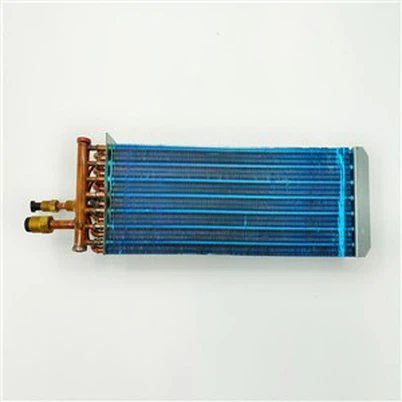


Function and principle of condenser
Leave a message
The condenser, as the name suggests, is the part that cools and condenses refrigerant into liquid refrigerant!
Its most important function is to complete the heat exchange of the refrigeration system. The condenser is a radiator in the air conditioning of the car, which distributes the heat of the refrigerant during the compressor compression to the outer space of the car, and turns the high temperature and high pressure gas discharged by the compressor into a medium temperature and high pressure liquid.
Does this mean that the heat absorption of the evaporator is the heat release of the condenser?
No. In fact, the heat released by the condenser = the heat absorbed by the evaporator + the operating heat of the compressor. The compressor inside is rotating, and the relative frictional motion of the components also generates heat!
So the heat dissipation of the condenser is greater than the heat absorption of the evaporator! At present, the main forms of automobile air adjustable heat exchangers are tubular plate type, tubular strip type and parallel flow type.
The structure of the condenser has been developed from tube type to tube type, mainly to parallel flow. Cascaded and parallel flow internal structures are continuously developed to further improve heat transfer efficiency and reduce weight. Parallel flow condenser has been developed from unit parallel flow type to multi-element parallel flow type. By reducing the thickness of the tube section, increasing the inner fin, cutting the fin, changing the fin shape and opening Angle, the heat dissipation area of the fin is increased, and the heat transfer efficiency between the gas side and the liquid side is strengthened.
The working principle of condenser condenser is used to release heat. The refrigerant is compressed by the compressor into the condenser, and the condenser has a capillary tube at the end. The capillary will produce resistance to liquefy the gaseous refrigerant compressed by the compressor to achieve the effect of heat release. The condenser is high pressure and will only be hot. The evaporator will be cold, and the liquid refrigerant of the condenser will be quickly vaporized after reaching the evaporator through the capillary tube, evaporating and absorbing heat, and achieving the refrigeration effect. The cooling capacity and heat are continuously circulated in this way to produce the refrigerant flow of the condenser: