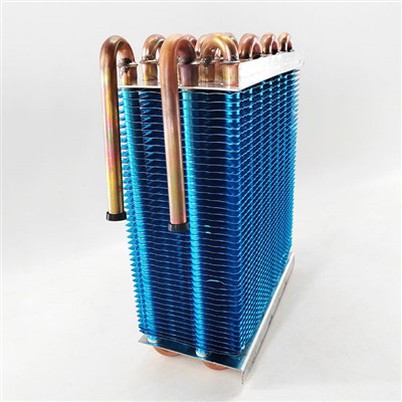


A detailed introduction of the condenser
Leave a message
The condenser is a heat exchanger that allows the gaseous refrigerant to release heat to the environmental medium to condense and liquefy. Its function is to allow the refrigerant to be reused, which condenses the refrigerant vapor from the evaporator to a liquid state. When the refrigerant vapor is condensed and liquefied in the condenser, the temperature and pressure are also kept constant, and the corresponding temperature and pressure are called the condensation temperature and condensation pressure. The condensing temperature increases with the increasing of the condensing pressure.
Condensers are divided into air-cooled condensers and water-cooled condensers due to different forces. Here, the working principle of these two condensers is briefly introduced.
1. Air-cooled condenser does not need cooling water, and uses air to cool high temperature and high pressure gaseous refrigerant. The heat transfer process is the same as other forms of condensers, there are three processes, respectively, to reduce overheating, condensation and re-cooling.
2. Water-cooled condenser uses water as a cooling medium, which is a device for cooling high-temperature and high-pressure gaseous refrigerants. The water-cooled condenser generally has a low condensing temperature, which is more powerful for the refrigeration capacity and operation economy of the compressor, and the cooling water used can flow once, and can also be recycled. When the general industrial screw compressor uses circulating water, it is necessary to establish a cooling tower.
The temperature and pressure of the liquid refrigerant condensed by the condenser in the refrigeration unit are the condensing temperature and condensing pressure, which are higher than the evaporation temperature and evaporation pressure, so it needs to be reduced and cooled before entering the evaporator. When the liquid refrigerant is in the throttling process, a small amount of friction heat is vaporized into vapor, so the refrigerant exported by the throttling device is a low temperature and low pressure wet vapor with very low dryness. When the refrigerant continuously undergoes a cycle of evaporation (boiling vaporization) → compression (pressure increase and temperature rise) → condensation (liquefaction) → throttling (pressure reduction and cooling) → re-evaporation (called the vapor compression refrigeration cycle), it can be continuously cooled to provide the required low temperature for the refrigeration environment.