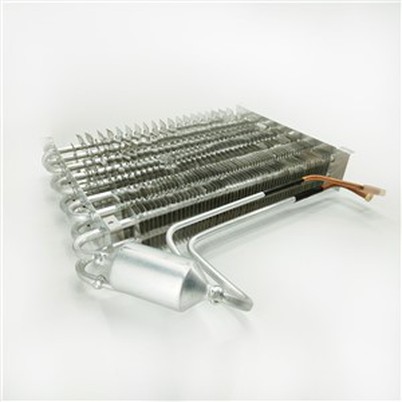


What is the function of the condenser?
Leave a message
Condenser is an important equipment for refrigeration system to release heat to the surrounding environment, and it is one of the four major components of refrigeration system. Condenser is a kind of heat exchanger, its main function is to quickly condense the high temperature refrigerant vapor into liquid, and release heat to the outside world.
For the vapor compression refrigeration system, the condenser condenses the high temperature refrigerant vapor discharged by the compressor into liquid refrigerant. The condenser is usually cooled by air, water and other normal temperature fluids, and sometimes cooled by other fluids with lower temperature. Condenser is an important equipment for refrigeration system to release heat to the surrounding environment, and it is one of the four major components of refrigeration system.
Therefore, whether the condenser is good or bad will directly affect the size of the refrigeration system refrigeration capacity and refrigeration efficiency. With the continuous development of the refrigeration industry and the rapid expansion of the application surface, the types of condensers emerge in endlessly, the cooling capacity is very different, and the efficiency is constantly improved. The commonly used condenser can be simply divided into three categories according to the cooling medium used: air (air) cooling (also known as air cooling), water cooling and water-air mixed cooling.
Air-cooled condenser refers to the condenser that condenses the refrigerant vapor into liquid with the air in the surrounding environment. According to the flow mode of air, air-cooled condensers can be divided into two types: natural convection and forced convection.
Water-cooled condensers use water for cooling. Because the thermal conductivity and specific heat capacity of water are much higher than that of air, the condensing capacity of water-cooled condenser is large, which is suitable for the selection of systems with large cooling capacity. The cooling water of the water-cooled condenzer can be tap water, and can also use river, lake and sea water (seawater is more corrosive), but the quality of the cooling water is better, the corrosiveness is small, and the hardness is small (not easy to form scale). The cooling water can be used once or recycled. The circulating cooling water needs to be equipped with cooling towers, cool pools and other equipment, so that the circulating cooling water can be used again after cooling in these equipment.
Water-cooled condensers can be divided into horizontal shell and tube type, vertical shell and tube type and casing type according to different structures. Water-air mixed cooling condenser uses two media of water and air for cooling, combines the functions of water-cooled condenser and cooling tower, which is water-saving and economical, and is suitable for suburban and rural use. This kind of condenser is divided into evaporative condenser and water condenser. In fact, the choice of condenser should be determined according to the size of the heat release, the use of occasions and water sources.
In a refrigeration cycle, the condenser acts as the component responsible for heat rejection. It removes heat absorbed by the refrigerant from the evaporator and transfers it to the surrounding environment. This process allows the refrigerant to change from a gaseous state to a liquid state and continue circulating through the system.
How Does a Condenser Work?
After leaving the compressor, the refrigerant enters the condenser as a high-temperature, high-pressure vapor. The condenser transfers heat from the refrigerant to air, water, or a combination of both. As heat is removed, the refrigerant condenses into a liquid and flows to the expansion device. This continuous process is essential for maintaining the cooling performance of the refrigeration system.
Factors Affecting Condenser Performance
Several factors can influence condenser efficiency, including ambient temperature, airflow, water quality, condenser cleanliness, and system load. Regular maintenance and cleaning help ensure stable operation and optimal heat transfer performance.
Frequently Asked Questions
Q:What is the primary function of a condenser?
-
The primary function of a condenser is to remove heat from the refrigerant and convert high-pressure vapor into liquid refrigerant.
Q:What is the difference between an evaporator and a condenser?
-
A: The evaporator absorbs heat from the refrigerated space, while the condenser releases heat to the surrounding environment.Q
Q:Which condenser type is the most efficient?
-
A: Water-cooled condensers generally provide higher heat transfer efficiency than air-cooled condensers, especially in large refrigeration systems.
Q: Why is the condenser important in a refrigeration system?
-
A: The condenser removes heat from the refrigerant and helps convert refrigerant vapor into liquid. It is an essential part of the refrigeration cycle.
Q: What can affect condenser performance?
-
A: Condenser performance can be affected by factors such as ambient temperature, airflow, water quality, and condenser cleanliness.