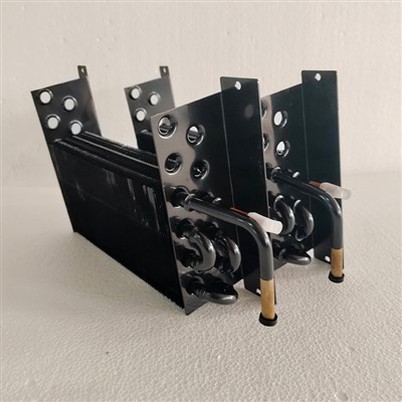



Walk In Cooler Evaporator
A Walk-In Cooler Evaporator is a key heat exchange component used in walk-in cold storage rooms to provide consistent and efficient cooling. It works by absorbing heat from the air inside the cold room and transferring it to the refrigeration system, helping maintain a stable low-temperature...
Description
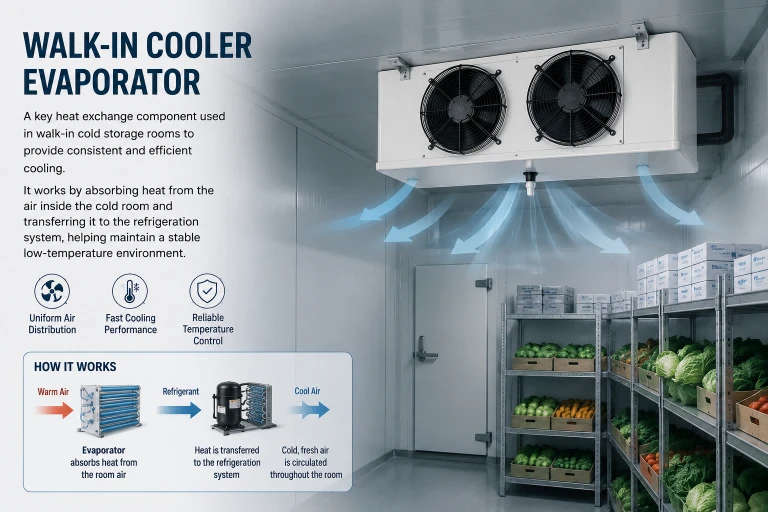
A Walk-In Cooler Evaporator is a key heat exchange component used in walk-in cold storage rooms to provide consistent and efficient cooling. It works by absorbing heat from the air inside the cold room and transferring it to the refrigeration system, helping maintain a stable low-temperature environment.
Typically installed inside commercial cold rooms, the evaporator ensures uniform air distribution, fast cooling performance, and reliable temperature control for stored goods.
System Position: Where the Evaporator Fits in a Refrigeration Cycle
To understand the function of a walk-in cooler evaporator, it is necessary to view it within the refrigeration cycle:
The compressor increases refrigerant pressure and temperature
The condenser releases heat to the surrounding environment
The expansion valve reduces refrigerant pressure and temperature
The evaporator absorbs heat from the cold room by evaporating refrigerant
Inside the evaporator coil, low-pressure refrigerant enters as a liquid-vapor mixture and absorbs heat from the surrounding air. As air passes through the finned coil surface, heat transfer occurs, causing the refrigerant to evaporate completely before returning to the compressor. In practical cold room systems, the evaporator is also responsible for: Maintaining temperature uniformity Managing humidity and frost formation Supporting airflow circulation patterns This means the evaporator directly affects storage stability, not just cooling speed.
Operating Principle in a Walk-In Cold Room Environment
A walk-in cooler evaporator operates in a controlled but dynamic environment. Unlike laboratory conditions, real cold rooms experience frequent disturbances such as door openings, product loading, and humidity fluctuations. The operating process can be summarized as follows:
Air from the cold room is drawn into the evaporator by axial fans
Air passes through the finned coil where heat exchange occurs
Refrigerant inside the copper tubes absorbs heat and evaporates
Cooled air is discharged back into the cold room
The cycle repeats continuously to maintain set temperature
Key physical processes involved:
Convective heat transfer between air and fin surfaces
Phase change of refrigerant inside the coil
Moisture condensation and frost formation on coil surfaces
The performance of this process depends heavily on airflow velocity, fin surface design, and refrigerant distribution stability
Installation Constraints in Real Cold Room Projects
Installation conditions play a critical role in determining long-term performance.
1.Structural Requirements
Ceiling load-bearing capacity must support evaporator weight
Vibration isolation may be required for large industrial units
2.Airflow Clearance
Adequate clearance must be maintained around air inlet and outlet zones
Blocked airflow significantly reduces system efficiency
3.Drainage Design
Condensate drainage must maintain proper slope
Poor drainage can result in ice accumulation and water overflow issues
Installation errors often lead to performance degradation even when equipment selection is correct.
Frequently Asked Questions
What is a walk-in cooler evaporator used for?
+
-
A walk-in cooler evaporator is used to absorb heat from the air inside a cold room by circulating refrigerant through a finned coil. It helps maintain a stable low-temperature environment for food storage, pharmaceuticals, and logistics applications.
What temperature range is suitable for walk-in cooler evaporators?
+
-
Most walk-in cooler evaporators are designed for medium and low temperature applications, typically ranging from around +5°C to -25°C, depending on system design and refrigerant type.
Why does frost form on the evaporator coil?
+
-
Frost forms when warm, humid air enters the cold room and moisture in the air freezes on the cold coil surface. This is a normal physical process in refrigeration systems operating below freezing temperatures.
How often does a walk-in cooler evaporator need defrosting?
+
-
Defrost frequency depends on operating conditions such as humidity, door opening frequency, and product load. It may range from a few times per day in high humidity rooms to less frequent cycles in stable storage environments.
How do I choose the correct evaporator size?
+
-
Selection depends on cooling load, room size, product type, insulation quality, and door opening frequency. Oversizing or undersizing can lead to unstable temperature control and higher energy consumption.
Hot Tags: walk in cooler evaporator, China walk in cooler evaporator manufacturers, suppliers, factory, condenser evaporator, evap aircon, evaporator and condenser coils, oil filter heat sink, radiator house heater, triple pipe heat exchanger
Send Inquiry
You Might Also Like