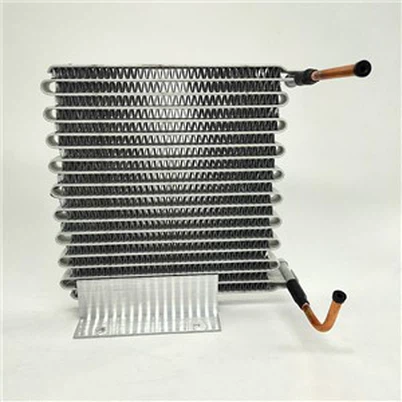



Condenser For Dehumidifier
Function 1 Heat Exchange The refrigerant, now in a high-pressure gaseous state, flows through the condenser coils. The coils are exposed to ambient air or are actively cooled by a fan that blows air over them. 2 Cooling and Condensation As the refrigerant gas flows through the condenser, it...
Description
Function

1
Heat Exchange
The refrigerant, now in a high-pressure gaseous state, flows through the condenser coils. The coils are exposed to ambient air or are actively cooled by a fan that blows air over them.
2
Cooling and Condensation
As the refrigerant gas flows through the condenser, it releases the absorbed heat into the surrounding air. This cooling process causes the refrigerant to condense back into a liquid state.
3
Return to the Evaporator
The cooled, high-pressure liquid refrigerant is then sent back to the evaporator to repeat the cycle. This continuous cycle of heat absorption and release ensures efficient dehumidification.
Design and Materials
The design and materials of the condenser are crucial for its performance and durability.
Coil Material
Condenser coils are typically made from copper or aluminum. Copper is favored for its excellent thermal conductivity and resistance to corrosion. Aluminum is also used due to its good heat transfer properties and cost-effectiveness. Both materials are often coated with protective layers to prevent corrosion and extend the lifespan.
Coil Configuration
The condenser coils can be designed in various configurations, such as finned or smooth tubes. Finned coils, which have metal fins attached to the tubing, increase the surface area for heat exchange, enhancing efficiency. Smooth tubes may be used in simpler designs but may have lower heat exchange efficiency.
Fan Mechanism
A fan is typically employed to blow air over the condenser coils. The fan helps dissipate the heat more effectively and can be designed to operate at variable speeds for energy efficiency.
Heat Dissipation
Some dehumidifiers use additional cooling mechanisms, such as air-cooled or water-cooled condensers, depending on the design and application. Air-cooled condensers are more common in residential units, while water-cooled versions are used in commercial applications where water is readily available.
Operation Cycle

Evaporation
The refrigerant absorbs heat from the air and evaporates in the evaporator coils, cooling the air and causing moisture to condense.
Compression
The refrigerant gas is compressed by the compressor, increasing its pressure and temperature.
Condensation
The high-pressure, high-temperature refrigerant gas flows through the condenser, releasing heat and condensing back into a liquid.
Expansion
The liquid refrigerant passes through an expansion valve or capillary tube, reducing its pressure and temperature before returning to the evaporator.
Hot Tags: condenser for dehumidifier, China condenser for dehumidifier manufacturers, suppliers, factory, shell and tube heat exchanger condenser, hydraulic cooler with fan, Copper Tube Blue Fin Condenser With Fan Cover, stacked heat exchanger, refrigeration condenser coil, fan assisted radiators central heating
Send Inquiry
You Might Also Like